January 1984: Austria’s Economy: Success through Talent and Determination
When you are very young, your dreams are big; but once those big dreams have shrunk, you are no longer young. Fortunately, not everyone waits that long. When Jean Pierre von Baksa was very young, he had a very big dream: to own paintings.
Well, you can collect stamps, or even save up for a sports car, but the finest works of art are quite something else. What followed sounds like a fairy tale, in an age when dreams always seem so terribly out of place – except in the cinema. Since he couldn’t buy the paintings, Jean Pierre von Baksa decided to paint some himself; and when talent asserts its right, there are no obstacles. He painted his first serious attempts on cardboard boxes from the cleaning firm; he found the paints at the Graphic Arts Training and Research Institute, where he had already failed the entrance exam; his mother’s cake spatula served as his palette knife.
His first painting to be sold still hangs today in Schönbrunn Palace – in a private collector’s collection. Despite initial successes, he found himself – one is tempted to say ‘naturally’ – in dire straits.
Sixteen years ago, the situation for young artists was no different from today. He waited a whole summer for the 1,500 schillings for the painting that the City of Vienna’s Cultural Office had purchased. A summer can be a very, very long time. Having learnt that public funding is of no use in the long run, he left the confines of the Alpine republic behind and gained experience throughout Europe. His vehicle was a microcar, and he made a living from the costume jewellery he made himself, which he sold in Brussels or Amsterdam, and of course from paintings he sold in places such as Hyde Park in London or at the Paris flea market. What was bound to happen eventually did: success! In return, he hired a Rolls-Royce and sold his paintings from the boot at English country houses and country clubs. Soon his name preceded him and his paintings, as the saying goes, flew off the shelves. And so another dream—a very universal one—became reality: his very own Rolls-Royce. That this very car can turn into a nightmare is another story. But the success remained; it took hold in almost all major European cities, and eventually even the world’s great graphic art collections could no longer ignore him: in 1971, the Albertina purchased the first painting bearing the Baksa signature. He has since been accorded this honour six times.
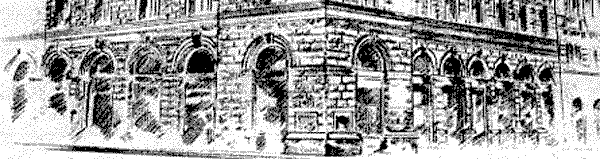
For the past ten years, Jean Pierre von Baksa has run a private gallery in Vienna’s Old Town, a former metal workshop that has retained its original character and serves not only as a gallery and workshop but also as a cultural and community hub.
Word of all this has spread to the ‘Who’s Who’, and in the picturesque old Viennese alleyways between Hof and Tuchlauben, people speak of the ‘founder’ of a business district of his own, for where there was once nothing, prestigious businesses now flourish. Someone has to make a start…
Collectors, but also businesspeople, are passing the baton to one another. Jean Pierre von Baksa takes care of everything. Advertising, management and design bear his signature.
He has a soft spot for young artists, helping them to realise their visions, all the more so because, as a self-taught man, no one helped him except his talent and his will.
His flat on Franziskanerplatz in the heart of Vienna is located in the building next door, where Maitre Leherb lives opposite, and the architect Holzbauer and UN Ambassador Jankovits reside in the same building. The flat is a testament to another of Baksa’s great passions – interior design: combining modern with traditional or rustic styles, alongside modern art, is his forte.
Due to his numerous residences in many cities around the world, his talent has also developed in this direction.
His ‘illuminated pictures’ – transparent images sandwiched between two glass panes, backlit by neon tubes and installed in window recesses or as door panels – have already set a precedent.
The rarer the courage to be unconventional, the more promising it becomes.
Which is exactly what needed proving.